


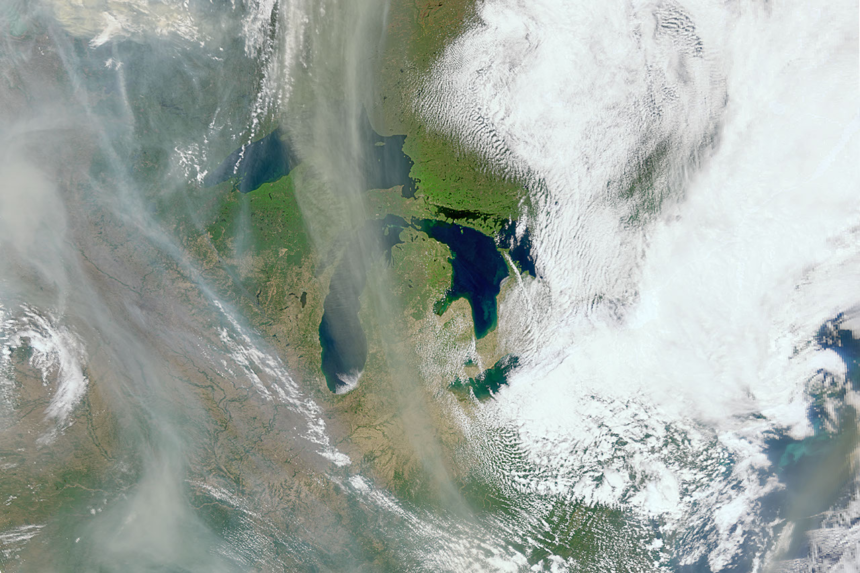
NASA’s PACE Satellite Monitors Smoke and Wildfires
With the North American fire season intensifying, NASA’s Plankton, Aerosol, Cloud, and ocean Ecosystem (PACE) satellite is leveraging its advanced instruments to track vegetation precursors to wildfires and smoke plumes. This real-time data enhances scientific understanding of fire dynamics and their environmental impacts.
PACE’s Multifaceted Capabilities
The satellite, launched in February 2024, combines ocean and atmospheric observation tools with unexpected terrestrial monitoring abilities. Its hyperspectral Ocean Color Instrument detects plant stress, dryness, and pigment balance—key indicators of high fire-risk zones. Land managers can use this data to allocate resources effectively, mitigating potential disasters.
Beyond fire detection, PACE’s ultraviolet sensors analyze smoke particles’ altitude and dispersion patterns. This information reveals how smoke travels across regions, impacting air quality and ecosystems. The instrument complements existing systems like MODIS by providing unique ultraviolet insights into particulate composition.
Atmospheric Insights from Advanced Instruments
PACE’s Hyper-Angle Rainbow Polarimeter 2 and Spectro-polarimeter for Planetary Exploration one analyze aerosol characteristics. By measuring light reflection, these tools distinguish smoke from other particulates—identifying smoke by its light-absorbing, dark appearance and small particle size. This differentiation aids in creating precise wildfire models and predicting future events.
According to Kirk Knobelspiesse, PACE’s polarimeter lead, the data will enable scientists to simulate emission scenarios. This could show how smoke from one region affects global systems, improving preparedness for climate-related fire risks.
Expert Perspectives
Skye Caplan, PACE’s terrestrial lead, emphasizes the satellite’s precision: ‘PACE observes land exceptionally well, offering vast exploration potential with its hyperspectral dataset.’ Erica McNamee, writing for NASA’s Goddard Space Flight Center, highlights the mission’s dual role in ocean and terrestrial research, underscoring its significance in climate science.